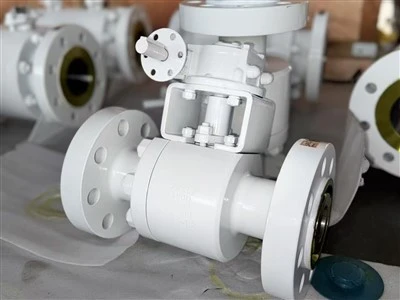

The Three Way Ball Valve features a three-way ball structure, allowing for media switching, diversion, or mixing through 90° rotation. It is suitable for pipelines carrying water, oil, gas, and some chemical media.
Technical Specifications
|
Parameter |
Standard Specification |
Custom / Optional |
|
Valve Type |
Three-Way Ball Valve |
Side-Entry / Top-Entry |
|
Port Configuration |
L-Port / T-Port |
Customized Flow Pattern |
|
Structure |
Floating / Trunnion Mounted |
According to Size & Pressure |
|
Nominal Size |
DN15–DN600 / 1/2"–24" |
Customized |
|
Pressure Class |
Class 150–600 |
Class 900–1500 |
|
Body Material |
WCB / CF8 / CF8M |
LCC / Duplex / Special Alloy |
|
Ball & Stem |
SS304 / SS316 / 17-4PH |
Duplex / Special Alloy |
|
Seat Material |
PTFE / RPTFE / PEEK |
Metal Seat |
|
Connection |
Flanged / Threaded / Welded |
Customized |
|
Operation |
Lever / Gear |
Pneumatic / Electric |
|
Design Standard |
API / ASME / EN / ISO |
According to Project |
|
Testing Standard |
API 598 / ISO 5208 / EN 12266-1 |
As Specified |
Port Configuration & Flow Pattern
L-Port: Connects different pipelines via ball rotation, enabling two-way flow switching, suitable for flow branching, bypassing, and media selection. The specific flow direction is determined by the ball's orifice and valve seat configuration.
T-Port: Offers various flow path combinations, enabling flow direction switching, media confluence, or multi-path distribution. The actual flow path depends on the ball's position and valve seat design.

Materials & Sealing
Body Materials: WCB, LCC, CF8, CF8M, and Duplex are available; special alloys can be customized according to project requirements.
Ball & Stem: Materials such as SS304, SS316, 17-4PH, and Duplex can be selected based on media and pressure conditions.
Seat Materials: PTFE and RPTFE are suitable for conventional fluids; PEEK is suitable for higher temperatures and pressures; metal seats are suitable for high-temperature or wear-resistant applications.
Manufacturing Capability
Precision Machining: CNC machining of key components such as valve body, ball, stem, and seat ensures precise control of dimensions and fit.
Assembly & Inspection: Cleaning, assembly, operational checks, pressure testing, and final inspection are conducted to ensure batch product consistency through standardized processes.
Custom Production: Customization is supported for caliber, pressure, material, flow path, connection method, and operating method. Production can be based on customer drawings or specifications.
OEM / Customization
Size & Pressure: Supports different calibers and pressure ratings, customizable to project specifications.
Flow Pattern: Supports L-Port, T-Port, and specified flow paths; configuration can be confirmed based on flow diagrams.
Material & Sealing: Materials and sealing solutions can be customized based on media, temperature, pressure, and corrosion conditions.
Actuation & Marking: Supports manual, pneumatic, and electric operation; logos, nameplates, serial numbers, and export packaging can be customized.
FAQ
Q: What is the difference between L-Port and T-Port?
A: L-Port is mainly used for switching the flow direction between two channels; T-Port offers more flow path combinations and can be used for switching, distribution, or specific mixed-flow conditions. Specific functions should be confirmed with a flow diagram.
Q: What is the difference between Floating and Trunnion Mounted?
A: Floating structures are suitable for more common diameters and pressure conditions; Trunnion Mounted structures, with upper and lower supports supporting the ball, are more suitable for larger diameters, high pressures, or applications requiring high operating torque.
Q: Can you configure pneumatic or electric actuators?
A: Yes. Appropriate pneumatic or electric actuators can be selected based on the valve's operating torque, pressure, opening and closing frequency, and control system requirements.
Q: Can you provide CAD drawings?
A: We can provide 2D dimension drawings and applicable 3D CAD files based on product configuration. Specific formats and delivery times will be confirmed based on the product model.
Q: Can you provide MTC and pressure test reports?
A: We can provide relevant material certificates, pressure test results, and inspection documents based on purchase specifications and order requirements.
Q: Do you support OEM/ODM?
A: Supported. Customization is available based on customer requirements for size, material, flow path, pressure rating, connection method, actuator, logo, and packaging.
Hot Tags: three way type of ball valve, China three way type of ball valve manufacturers, suppliers, factory, ball valve, Double Ball Valve, Floating Type Ball Valve, Hard Face Sealing Ball Valve, Soft Sealing Ball Valve, Three Way Type Of Ball Valve